
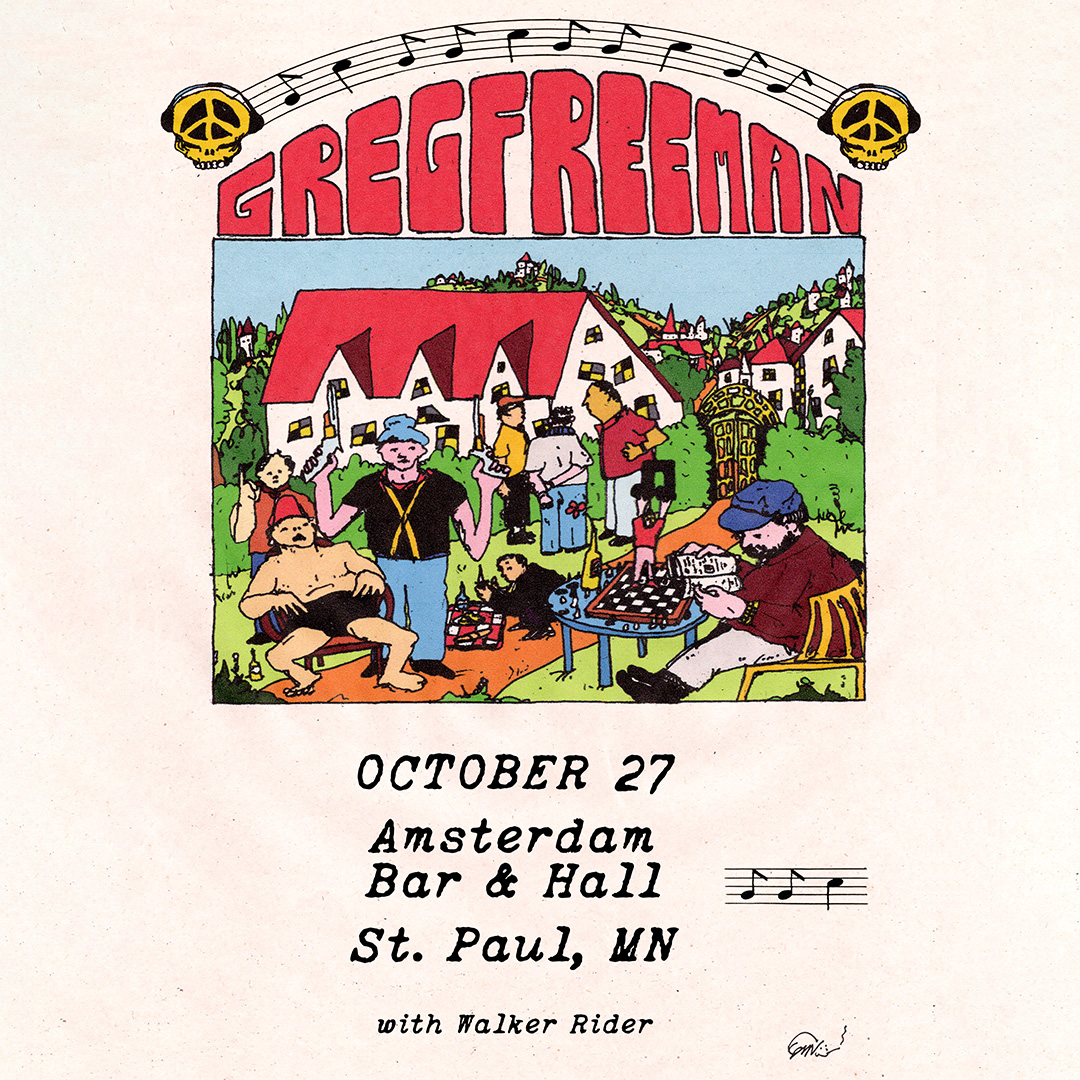
Greg Freeman won’t be getting comfortable anytime soon. Across New Mexico, Vermont, Los
Angeles, and a long stretch of tour stops hooking those places together, All Set The Bone came
alive. While writing and recording it, Freeman moved out of his longtime home in Burlington, holed
up in a middle-of-nowhere part of the Southwest, and stepped into music full-time, leaving behind
odd jobs as a cemetery landscaper and restaurant line cook. The following album is populated by
a grain of similarly unsettled people: a voter buried in credit card debt, a pair of Christian hearts
clanking like trapped lobsters, a town of bent necks, a lover with limbs bent like crabapple trees.
Freeman calls All Set The Bone a “reflection of a lot of change, and a lot of tension.” It’s a box of
political and personal yarns spread across four sides, “inhuman events” and grief pulled into a
“perfect tsunami.”
Freeman was barely done making Burnover when he started writing its successor. He chased
disruptions with confidence, creating on impulse rather than familiarity. “I had this epiphany
moment where I understood what the next record should be,” he says, “which surprised me,
because I thought it would take a lot longer to have the influences or inspiration required to
undertake writing a new album.” What arrived instead were radioactive songs that never seemed
overworked or moralizing. There may as well have been a “no overthinking” sign pasted above
the studio door.
Traces of pre-Good News Modest Mouse and early Pavement linger, but All Set The Bone resists
easy lineage through a deliberate fracture that’s twisting yet familiar. Freeman’s longtime
obsessions with Fugazi and Unwound color the album’s heavier dirges—like “Hail Mary”’s math-
rock chords snapping against post-hardcore distortion—and its spangled outposts grew from a
diet of Big Star, The Drones, and Mission of Burma. The best parts of All Set The Bone blink like
psychotic blues ramp-ups, while the heavy-metal/weeping violin onslaught of “Untitled 10” leaves
room for punches of brass. Lyrically, Freeman’s pen is too strong for analogy, as he riffs on bodies
turned to ground beef, or chasing a dream but settling for a niche.
After Burnover’s queasy fixation on ghost stories and various New York locales and histories,
Freeman again returns to the immediacy and anxiety of time and history, building a choir of
questions out of constellations where “the light pours in the like hourglass sand.” Opener
“Cahokia” is titled after the ancient Indigenous mounds that sit on the Illinois side of the Mississippi
River, whose builders disappeared. Freeman uses taxidermy and amber-casted bugs to
contextualize songs about love and grief in “Untitled 10.” Near the end of side one, he even makes
this striking declaration: “No culture, and no more rock and roll.” But “Decade” may sum All Set
The Bone up best: “History rubbernecks at each of your darkening thoughts.” Freeman says
there’s a “sense of time running out, of us becoming stuck in the trajectory of our own history.” It’s
a theme that he’s been unpacking since I Looked Out, but he’s never done it better than right here
in these seventy minutes.
And what we get is paradoxical: Freeman’s most exposed writing but also his most evasive. Songs
like “Costs” cut closer to direct confession: “in the flash of puke’s surrender, I relive life through
every bender,” or the “thousand gears between my ears, working overtime to taxidermy every
worthy heartbreak into rhyme.” But much of All Set The Bone is grounded in second-person. It’s
not used as a tool for distance, but a means of rejecting any prescriptive tones. When Freeman
asks, “Do you feel your world will shatter at the slightest touch? Is it the child in you that’s scared
to feel too much?,” the effect never sounds sanctimonious.
Freeman’s audience ignited like brimstone in 2023. Songs like “Come and Change My Body”
have eclipsed the critical circles that first engaged with his music, making Freeman a bonafide
threat to indie-rock’s throne. The attention, he says, still catches him off-guard. “I never get used
to that, or take that for granted,” he says. “But, on the flip side, I don’t think about it too much
when I’m writing music, and I think that’s important when you’re making something genuine. It’s
about what you want to make, not what other people want.” That stance has become more
complicated now that music is what pays his bills. Touring occupies most of his calendar, while
recording happens in the gaps it leaves open. Instead of enjoying a multi-year hiatus between
Burnover and All Set The Bone, he pushed straight into the latter, emerging with an hour of total
music devotion.
He assembled a band built to embody and obliterate contradiction—to walk the tightrope between
chaos and precision. The “I wanna feel like a drummer, felt but not shown” line in “Indu” says it
best, as the Greg Freeman Band is at its most spectacular when parts are heard as a sum.
Freeman’s longtime collaborators Garrett Linck and Sam Atallah, Florry’s Joey Sullivan, and The
Rockin Worms’ Carney Hemler lived with him in the California desert, practicing for a few weeks
before hitting record. He’s also joined by songwriters Anna McClellan and Trinity Ace, whose
vocal ranges complement the distinctiveness of his shrill, creaking voice rather than overwhelm
it. Freeman doesn’t ask for much from his duet partners. “Someone who can sing with me and
make it sound good” is enough. McClellan’s “high glottal” rises above his upper range, while Ace’s
deeper harmonies sit naturally beneath his.
Where I Looked Out and Burnover were made closer to home in Vermont, All Set The Bone was
redirected westward, landing in Los Angeles under the guiding hand of producer John Congleton.
The shift from Burlington staple Benny Yurco to Congleton seemed like a risk initially, but his and
Freeman’s chemistry proved immediate. “Even when you can’t describe exactly what you want,
he knows what you’re talking about,” the guitarist says. The sessions flourished through instinct:
the album’s rawest moments, like “Bury Me The Shovel,” were treated as live, impromptu
propositions from the outset, built to remain unpolished. In “Loser’s Prize,” Freeman writes about
the fears of love “nursed by catastrophe, yet protected by the limits of its own memory.” Just as
he did on I Looked Out and Burnover, he dives well and far here into what it costs to live through
the present moment, and his band’s instrumentation mirrors that with dense song structures and
spacious improvisation.
Freeman made I Looked Out without expectation or remorse. On All Set The Bone, he embraces
friction instead of refusing it, using scant rehearsal times and urgent, self-appointed deadlines to
fill his third album with ambitious whims: smile-stretching guitar scorchers, cosmic percussive
surges, near-baroque piano riffs, psych-rock noodles, brass cutouts, and enough key changes to
build an unsolvable musical maze. All Set The Bone was finished quickly, in a real Hollywood
studio with one of rock’s best modern architects, and with minimal separation between idea and
outcome. For Freeman, uncertainty has become his wealthiest currency. “It should never feel
comfortable,” he says. “Every album should scare you.”